System for Demand-Responsive Mobility
The federally funded NeMo.bil project celebrates its successful completion
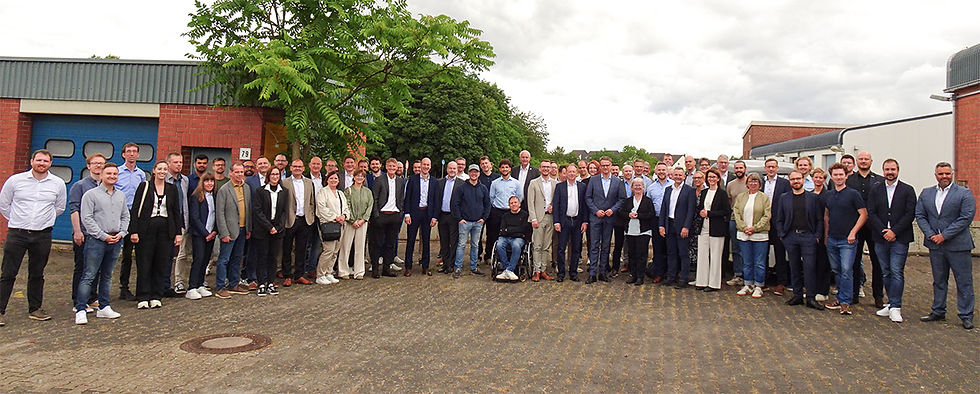
The participants have drawn a very positive balance at the conclusion of the NeMo.bil project, which was initiated by the Neue Mobilität Paderborn e. V. (NeMo) association. Funded by the Federal Ministry for Economic Affairs and Energy with around 18 million euros, the project developed and built prototypes for a novel mobility system for demand-responsive passenger and freight transport. At the closing event held at the Zukunftsquartier (Future Quarter) in the city of Paderborn, high-ranking representatives from federal politics and the ministry gathered with the project partners.

The NeMo.bil project pursued an innovative approach using two coordinated vehicle types. Swarms of smaller autonomous vehicles (Cabs) serve the first and last miles. On longer routes, they combine into a convoy pulled by a larger vehicle (Pro). This system is ideally suited to enable resource-conserving, individual public transport, particularly in rural regions.
At the closing event in Paderborn's Zukunftsquartier, guests were able to experience the project's results in their entirety for the first time. Stakeholders from politics, business, science, and administration gained insights into the developed vehicles, digital applications, and technical systems. Discussions throughout the specialist exhibition and driving demonstrations showed how the individual building blocks of the mobility concept work together and what potential they unlock for the mobility of the future.
Consortium Leader Marcus Zwick emphasizes: "What inspired me about NeMo.bil from the very beginning is the focus on the big picture: not a single technology, but an end-to-end system that truly moves people. Connecting rural areas—regions that are often left behind by traditional public transport services—is particularly close to my heart. I am convinced that autonomous, emission-free shuttles can make all the difference here: reliable, comfortable, and accessible to everyone. NeMo.bil has shown that this is no longer a vision of the future—it is feasible."
"As NeMo e.V., we will actively utilize the insights gained in the NeMo.bil project. In doing so, our association will evolve from a network actor into the leading platform for the implementation of autonomous mobility in the Hochstift region. With this new orientation, we will rise to become a visible pioneer region and set further strong benchmarks with a supra-regional impact," emphasizes NeMo Chairman Christoph Rüther, District Administrator of the Paderborn district.
While the project duration ends with the successful completion of NeMo.bil, NeMo e.V. will continue the further development of the resulting solutions. The lightweight vehicles developed in the project for the first and last mile form an important foundation for future swarm mobility concepts. Here, the focus is particularly on the further development and industrialization of the systems. The resulting prototypes are to be deployed, tested, and gradually optimized in follow-up projects.
The towing vehicle, Pro, also offers diverse perspectives beyond the original approach. In addition to further investigating convoy operations, the focus is particularly on the vehicle's potential as a mobile charging station for various use cases. The coupling system developed in the project will not only enable the automated formation of vehicle convoys in the future but also opens up new possibilities for the automated charging of autonomous vehicles at individual charging stations.
Furthermore, the results in the field of the digital system can be utilized in the long term. Many of the components, developed according to open-source principles, are accessible to the specialist and developer community. As a result, the insights gained can flow into other applications and contribute to general progress in the field of connected and autonomous mobility. About the NeMo.bil Project
Numerous partners from industry and science participated in the NeMo.bil project: Aspens GmbH, AVANCO Composites GmbH, CADFEM Germany GmbH, CP Tech GmbH, Deutsches Zentrum für Luft- und Raumfahrt e.V. (DLR), dSPACE Group SE & Co. KG, FIWARE Foundation e.V., HOLON GmbH, INYO Mobility GmbH, LIA GmbH, Neue Mobilität Paderborn e.V., PHOENIX CONTACT E-Mobility GmbH, Poppe + Potthoff GmbH, Reisewitz GmbH & Co. KG, Technische Hochschule Augsburg, Technische Hochschule Ostwestfalen-Lippe, Technische Universität Dortmund, Universität Paderborn und das Wissenschaftszentrum Berlin.
More Information: www.nemo-bil.de

